

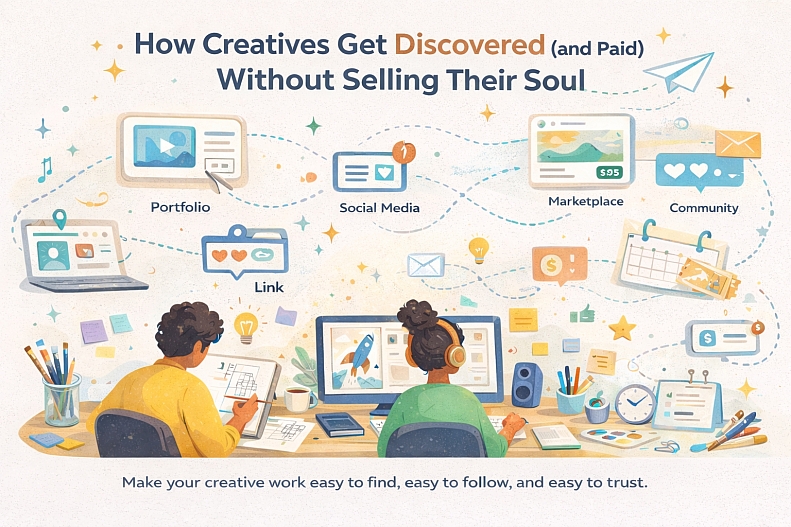
How Creatives Get Discovered Without Selling Their Soul
Creatives—illustrators, filmmakers, designers, writers, musicians, makers—don’t usually struggle because their work is “bad.” They struggle because discovery is messy, inconsistent, and often controlled by platforms that reward frequency over depth. The good news: getting found is learnable, and you can build it like a practice, not a lottery ticket.
What follows is a practical way to make your work easier to find, easier to trust, and easier to buy—without turning your life into a 24/7 content machine.
The quick take you can screenshot
Discovery improves when you do three things at the same time: (1) make your work legible in seconds, (2) make it easy to follow up in one click, and (3) show proof that real people want what you make. Do that consistently for 8–12 weeks and you’ll usually see clearer signals: more replies, more saves, more repeat visitors, better referrals.
A tiny map of where discovery tends to happen
|
Channel type |
What it’s good at |
What to watch out for |
Best use case |
|
Portfolio networks |
Being found by clients/art directors |
Work can blend in if unfocused |
Targeted, niche portfolio |
|
Reach spikes and trend-driven attention |
Fast burnout, shallow intent |
Teasers → send to home base |
|
|
Marketplaces |
Built-in buyer intent |
Fees + competition |
Clear products, fast fulfillment |
|
Direct-to-fan platforms |
Loyal supporters and repeat sales |
Takes time to build |
Music, zines, prints, memberships |
|
IRL/community |
Deep trust, strong referrals |
Slower scale |
Workshops, local scenes, collaborations |
School can be part of the plan (especially if business is your weak spot)
If you feel solid creatively but shaky on pricing, positioning, or sales, going back to school for a business degree can sharpen the skills that help you market and sell your art. One path is earning a business management degree to build your skills in leadership, operations, and project management. And if you’re balancing commissions, gigs, or a day job, consider an online degree program—this may help make it easier to keep creating while you study at the same time.
How to get discovered in 30 days (without losing your mind)
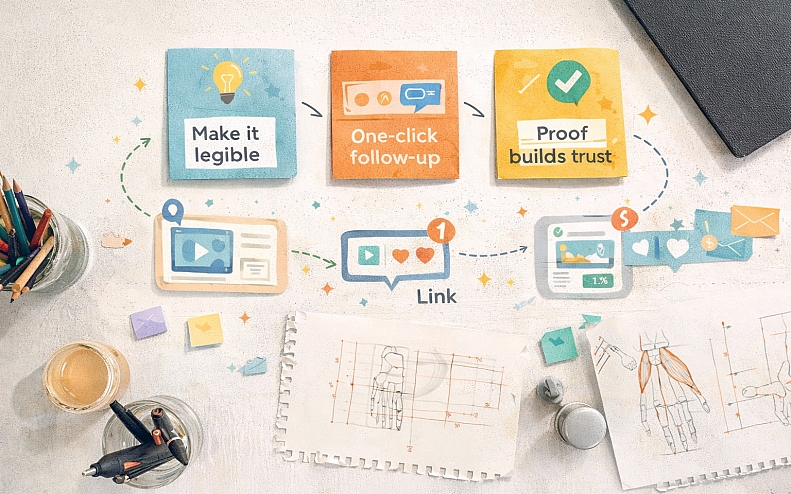
Week 1: Build the “home base”
- Pick one primary page (website, portfolio, storefront).
- Put your best 6–9 pieces first.
- Add one obvious call-to-action: “Hire me,” “Buy prints,” “Listen,” “Join.”
Week 2: Create three “front doors”
- Post one behind-the-scenes process snippet.
- Post one finished piece with a short story (what it solved, what you learned).
- Post one “offer” post (what you sell, price range or starting point, how to buy).
Week 3: Borrow attention
- Collaborate with one peer (swap skills, bundle, remix, duet, guest post).
- Pitch one newsletter, blog, or community that already serves your audience.
- Comment meaningfully in 10 places where your buyers hang out.
Week 4: Turn interest into income
- Follow up with everyone who engaged: “Want the link/rate sheet / next drop?”
- Make one limited offer (10 slots, 20 prints, one weekend sale).
- Ask for one testimonial or review from a happy buyer.
FAQ
How do I pick a niche without getting boxed in?
Choose a niche like a season, not a prison. Pick the overlap of what you enjoy, what you’re good at, and what people already pay for—then revisit every 3 months.
Do I need to post every day?
No. You need consistency, not constantness. One strong post per week, plus a light community presence, often beats daily low-energy output.
What if my work spans multiple styles?
Curate separate “lanes.” Either split portfolios (tabs, sections) or rotate focus month by month so your audience knows what to expect.
How do I price when I’m still “unknown”?
Start with a baseline that covers time + costs + a small profit, then raise prices when you’re booking consistently or selling out drops.
A resource worth bookmarking
If you want structured, artist-friendly career guidance (without the influencer haze), Creative Capital’s Artist Resources is a solid place to roam. It collects professional development tools, opportunities, and learning resources designed specifically for working artists. Browse it when you’re stuck on the “business” parts of your practice—grants, contracts, proposals, sustainability.
Getting discovered is less about being everywhere and more about being easy to understand and easy to support. Give people a clear first impression, a simple next step, and consistent proof that your work lands. Run a 30-day experiment, keep what works, drop what drains you, and iterate like a craftsperson—not a content hamster. Your passion can pay bills, but it needs a path.
Categories
Recent Posts



0.0863